

The Himba People of Namibia: Balancing Tradition and Today
The Himba people of Namibia are a fascinating tribe!
Namibia is a land of stunning landscapes and diverse cultures, but I don’t think culture is as captivating as the Himba people.
They wear their skin coloured with red ochre and their hair intricately styled. The Himba people are a testament to the beauty and diversity of human culture.
In this article, we’ll take a closer look at the intriguing world of these indigenous Namibian people. We’ll explore their history, traditions, and way of life.
They will leave you with a new appreciation for the rich cultural heritage of Namibia.
Let’s go!
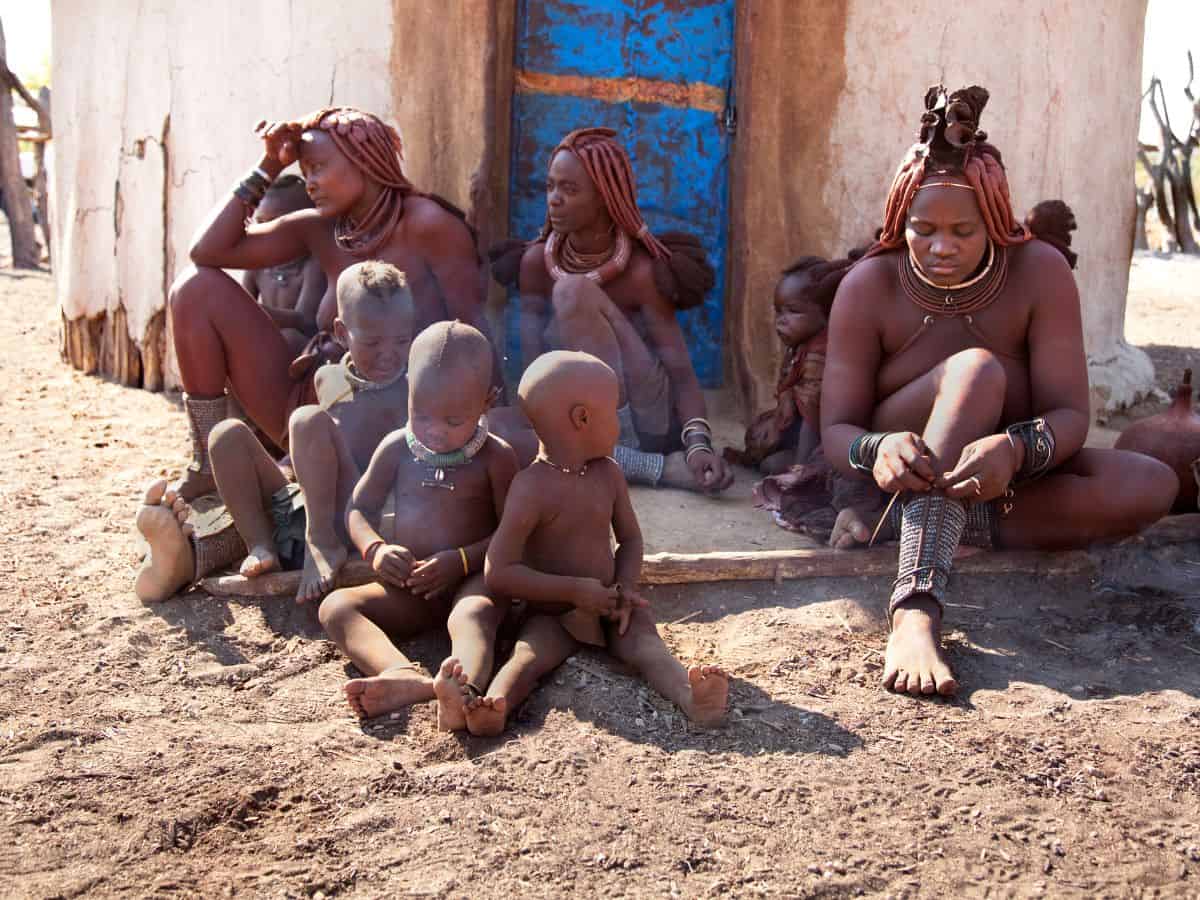
The Himba People of Namibia
Namibia’s many small family villages of Himba people are called ogandas. These villages can be found in the remote northern part of the country, in the Kunene region bordering Angola.
This border is marked by the Kunene River. There are villages of Himba on the other side of it as well, in southern Angola.
This Kunene region, once known as Kaokoland, is characterized by arid and semi-arid landscapes – typical of the majority of Namibia.
The Himba people are semi-nomadic pastoralists, or herders. They have traditionally relied on their livestock, mainly goats, sheep, and cattle, for survival.
Due to the aridness of the terrain they live on, they need to move their herds often to find water and grazing areas.
It’s usually the men who take care of the livestock, leaving the village to find what the animals need. They may be gone for days or months, and the women keep the village running.

Their huts are made of mud, sticks, and dung, with thatched roofs. They grow some crops as well, mostly maize and millet.
This is the way the Himba have lived their lives for generations – year to year and season to season. But the modern world is expanding, and the conveniences of that world are tempting.
Some members of the tribe are now attending modern schools. The women of villages near urban centres, like the Kunene Region’s small capital of Opuwo, will visit town supermarkets for food.
They’ll seek modern medical care there, too.
The modern world is infringing on the old ways, and the Himba way of life is at risk. The question is, will the old traditions survive?
Here are a few things that will be lost if they don’t.

Traditional Himba Religion
The Himba people have a rich cultural heritage and many traditions that have been passed down from generation to generation.
For example, they are animistic people and believe that animals, objects, and even places each contain their own spirits.
Fire, called okuruwo, is especially sacred. Holy fire is the link through which the Himba communicate with their deceased ancestors.
And through these venerated ancestors they communicate with their god Mukuru.
A piece of the fire is kept burning always, in the centre of the village. There is a fire-keeper who is assigned this important task.
Omiti, a form of black magic or “bad medicine”, is also a part of the Himba culture. It is believed that serious illnesses or bad thoughts in good people may be caused by the use of omiti.

Himba Beauty
One of the most striking characteristics of the Himba people is their appearance. The women are known for the distinctive red-ochre coloured paste they use.
The past is called otjize, and is a mixture of butterfat and ochre, a natural, red clay pigment found in the local soil. The fragrant sap of a bush called omazumba may also be added. The paste is rubbed over the face, body, and braids.
It is commonly assumed that the paste is used as protection from the sun and insects. However, while it may serve these purposes, too, members of the Himba tribe have said that women use it for aesthetic reasons.
Another purpose of otjize is as a part of their hygiene practices. With water in such short supply, the Himba have found different ways to keep clean.
Whereas men will bathe with river water, women use ochre powder on their skin to keep it clean. They may also steep their bodies in the smoke of burning herbs, trapping the smoke around them with blankets or wraps.
Wood ash is widely used as a hair cleanser as an alternative to methods that require water.
As well as the red otjize on the skin, the braids of their hair are often coated with the paste. The hairstyles of the tribespeople vary from family to family, and from one life stage to another.
The meaning behind the different styles is actually fairly complex, but the females of the Himba tribe are typically kept in braids that are coated with the otjize.
The style of braid is different for very young girls than for those approaching puberty. It will change again when she is old enough to be considered for marriage.
Once a young woman becomes a wife or a mother, a decoration made of sheepskin is added to the top of the head. This “crown” is called an erembe and can be quite ornate.
Throughout these stages of life, there may be extensions added to the braids made of goat hair or straw. Very young children may be completely shaven or have just a bit of hair left at the top of the head.
The styling of hair is a bonding activity among the women in a village and can take up a large portion of their day.

Himba Jewellery
Jewellery is another important aspect of a Himba woman’s dress. It signifies status and is worn nearly constantly; it’s a part of who they are. Neck, arms, wrists, ankles, and hair can all be highly decorated.
The jewellery is created from leather, bone, and ostrich eggshells, as well as plastic and copper wire. These are often covered with the terracotta-coloured otjize, too.
The ohumba is the piece with the most significance. Consisting of metal beads supporting a cone shell pendant, it’s passed down through families and symbolizes fertility.

What about the men?
You may be able to tell a few things by the way a Himba man wears his hair, too. Single men tend to wear a single braid, an ondatu, pulled back from the face.
Once he’s taken a wife – or two – he’ll abandon the braid and don a cap or head scarf. A man whose wife has passed away will uncover his hair and will wear his head bare.

Traditional Clothing
The traditional dress for both men and women is garments made from calf or sheepskin. Both genders wear only a leather or cloth covering from the waist and around the hips, leaving the torso exposed.
This a practical form of dress in this hot climate. As the culture does not sexualize a woman’s breasts, there is no stigma surrounding a woman having hers uncovered.
If footwear is worn, a woman will usually wear sandals made from the skin of cattle. Men, on the other hand, most often wear sandals made from old car tires.

A Day in a Himba’s Life
The Himba people of Namibia, though also growing a few crops, are primarily livestock herders. And the tending of the animals is left to the men.
For this reason, Himba villages might seem to be occupied predominantly by women. Men spend a great deal of time away, searching for enough grass and water to keep their herds healthy.
The tribe keeps sheep and goats, too, but cattle are especially significant in the Himba culture. They signify wealth and social standing and are also an important part of marriage negotiations.
While the men are tending the animals, the women take care of everything else. From cooking and caring for the children to digging in the ground for water and building the huts.
The women of these tribes have kept the Himba people adapting and surviving here for generations.
Visit the Himba Tribe on the 20-Day Victoria Falls from Cape Town tour in this article.

The Struggle to Maintain Tradition
Unfortunately, it is not always easy to live by tradition alone. It can take as little as a lion taking down a village’s last two animals to force a family into the nearest town.
Parents who sense changes coming their way are sending their children to schools outside their villages. Many young people are lured to urban life by the enormously different life it offers.
But prejudice against the easily recognizable Himba is common. This is true whether in the region’s capital of Opuwo or in the modern schools.
Those dressed traditionally aren’t welcomed and are made to feel ashamed. It’s difficult for tribespeople to find work in the village, regardless of the reason they’ve made the move.

Often alcohol becomes a problem, and crime and prostitution have been known to follow.
Government assistance is available, but works as well as many of these programs tend to. The money is not enough, takes too long, and often doesn’t arrive at all.
The Himba have managed to maintain their traditional customs and way of life for generations. They’ve adapted and evolved as needed to survive in their harsh environment.
There is no official census, but it’s estimated that fewer than 50,000 Himba people remain in Namibia today. Out of those, only a small percentage still live a traditional lifestyle.
Will the 21st century be the last for this admiral and fascinating tribe?

More Interesting Facts About the Himba Tribe:
1. A Himba man can have more than one wife if his first wife agrees. However, a Himba woman can only have a single husband.
2. A husband can be selected by a Himba girl’s father once she’s begun menstruating. This could be as young as 9 or 10 years. This is illegal in Namibia but is still common.
3. Music, singing, and dance, as well as storytelling are important parts of Himba culture.
4. They speak a language called Otjihimba, which is closely related to Herero, a related ethnic group.
5. They subsist largely on a porridge of corn flour and goat’s milk, eating meat only on certain occasions. Due to economic hardships, there are times when the tribe may not have food for a day or more.
6. Villages can be as small as a few huts, or as large as a dozen.

Himba Tribe Frequently Asked Questions
What is the Himba tribe known for?
The most immediately striking feature of the Himba people is the terracotta tinge to the women’s skin, and the elaborate braids in the same colour.
What do the Himba people believe in?
They are animistic people and believe that animals, objects, and even places each contain their own spirits.
Fire is especially sacred, and is the link through which the Himba communicate with their deceased ancestors. Through these ancestors, they communicate with their god Mukuru.
What is the history of the Himba people?
As early as the 16th century, the Herero tribe migrated from the north and settled in what is now the Kunene Region of northern Namibia. When disease decimated their cattle, much of the tribe moved south to search for new opportunities.
Those who decided to stay came to be known as the Himba – literally “beggar”, as they were forced to and those they met for help.
Summing It Up – the Himba People of Namibia
From their intricate hairstyles and jewelry to their communal way of living, the Himba offer a glimpse into a fascinating and beautiful world that is both ancient and timeless.
While they have maintained their unique culture and customs for generations, they are now facing a number of challenges that threaten to erode their way of life.
Economic challenges, environmental degradation, and the encroachment of tourism and westernization. These are just a few of the issues that the Himba must grapple with if they are to survive and thrive in the years to come.
It’s clear that the future of the Himba people is uncertain. However, the strength and resilience that is evident from their years in this harsh land give me hope that they will be able to find a middle ground between tradition and today.
Read more about Namibia:
➵ Namibia’s Best Beaches for a Blissful Summer
➵ 25 Fun Facts About Namibia
➵ 20 Photos to Inspire You to Visit Namibia
➵ The Best Namibia Trip Planner for 2023
➵ Find Your Dream Destination in Africa
