
Cabot Trail Road Trip Dilemma: Clockwise or Counterclockwise?

Exploring the Cabot Trail in Nova Scotia is an unforgettable adventure – it’s a world-famous road trip! The views, the spectacular natural beauty, and the lobster are legendary.
But the direction you choose to drive can shape your experience. Whether you decide to go clockwise or counterclockwise, each option has unique advantages and spectacular views.

Let’s dive into the good and bad of both to help you choose the best route for your journey.
Cabot Trail: Clockwise vs. Counterclockwise – Which Way to Go?

Going Counterclockwise: A Gentle Climb with Ocean Views on Your Side
Driving the Cabot Trail counterclockwise is a popular choice for several reasons.
First, it can feel less intimidating. This lane will usually put you away from the cliff edges on the mountainous parts of the trail.
This is a big plus if you’re not keen on heights. Or if you’re driving a larger vehicle that might feel bulky near the edge, you may prefer it here.
As well, when you travel counterclockwise you’ll find that most of the scenic pull-offs are on your side of the road. This makes it easier to stop, stretch your legs, and take photos of the dramatic landscapes without having to cross traffic.
If you want to go home with some great pictures, or if you love to take your time soaking in the views, this is a pretty significant advantage.
Or, maybe you’re driving an older or less powerful vehicle, like my ’87 VW van. Going counterclockwise might be easier on your engine.
This direction involves fewer steep climbs. It will let you enjoy a more relaxed drive without pushing your vehicle too hard. It may still be slow going, though.
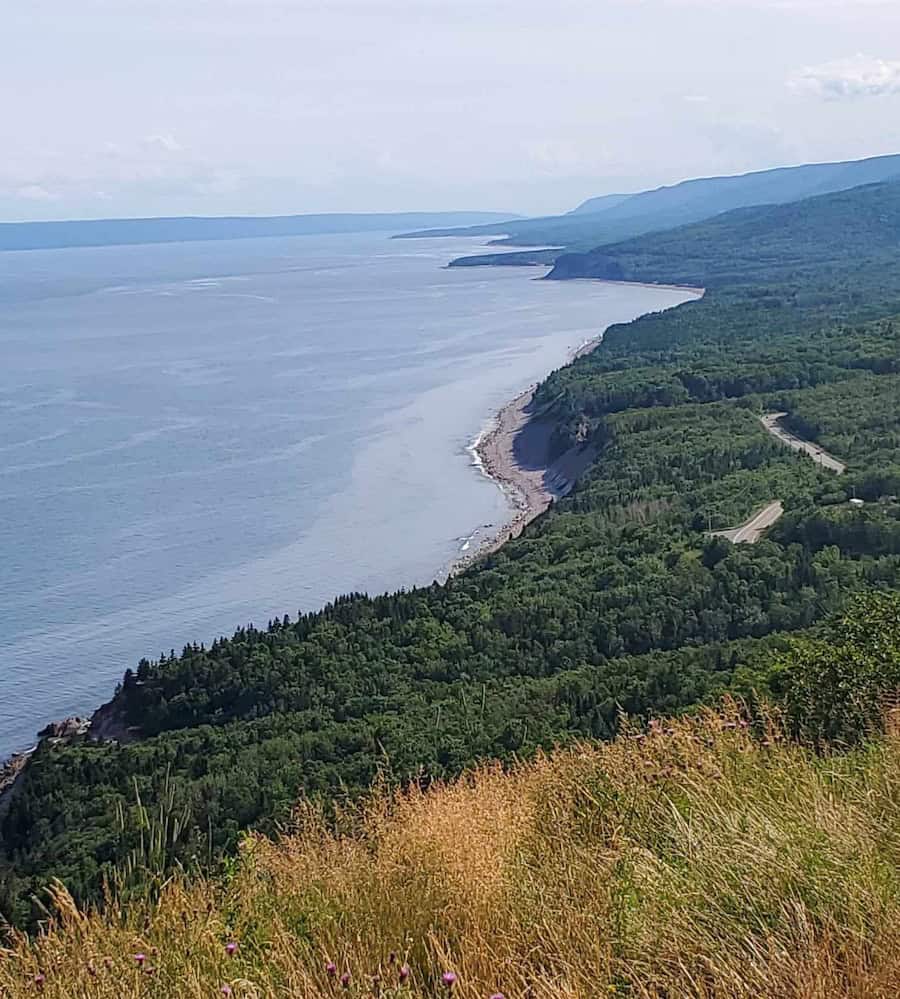
Choosing Clockwise: Embracing the Challenge with Rewarding Downhills
On the other hand, driving clockwise presents its own set of pros.
Yes, it involves tackling a few steeper climbs, especially through the northern sections in Cape Breton Highlands National Park. But these ascents are rewarded with fun downhill stretches.
These allow for easier braking and stopping, too. This can be a bonus when pulling over at one of the many spectacular viewpoints.
Travelling clockwise can offer a different perspective on the scenery, too. With the ocean to your left on the east side of the trail, the views can be more dramatic.
They’ll often appear suddenly as you round a bend. The east side of Cabot Trail, especially, is all about the views.

When you’re driving in the opposite direction, some of the vistas can be missed. That is unless you’re checking the rearview, or looking over your shoulder. On the other hand, you see more of the colourful hillsides in the autumn.
Some will also argue that the clockwise route is a better visual experience during sunrise or sunset. If you’re an early bird or a sunset chaser, this might be the deciding factor for you.

The Verdict: It’s Stunning Either Way
Ultimately, the direction you choose depends on what you value most in the drive. Do you prefer ease and accessibility or the thrill of the climb and dynamic views?
Both directions will give you a journey filled with stunning landscapes and memorable moments.
If you’re lucky, you’ll have the opportunity to travel the trail in both directions. This way, you won’t miss out on anything it has to offer.
Regardless of your choice, you’re in for an incredible treat. So recharge your camera battery, fill the tank, and stock up on road trip snacks!
See you around the trail!
Read more:
🚙 Comprehensive Guide to the Cabot Trail, Cape Breton
🦞 Cabot Trail Campgrounds: Cape Breton Highlands National Park for 2024
🏞️ Canada Park Pass to Explore the Cabot Trail in 2024
🚵🏻 29 Things to Do On the Cabot Trail: An Epic List for Your Cape Breton Road Trip
